What is the Track Sheet and What Does it Tell You?
Most beat stores show you a title, a price, and a play button. That’s it. You’re supposed to just vibe and figure out the rest later. I wanted to offer something more though.
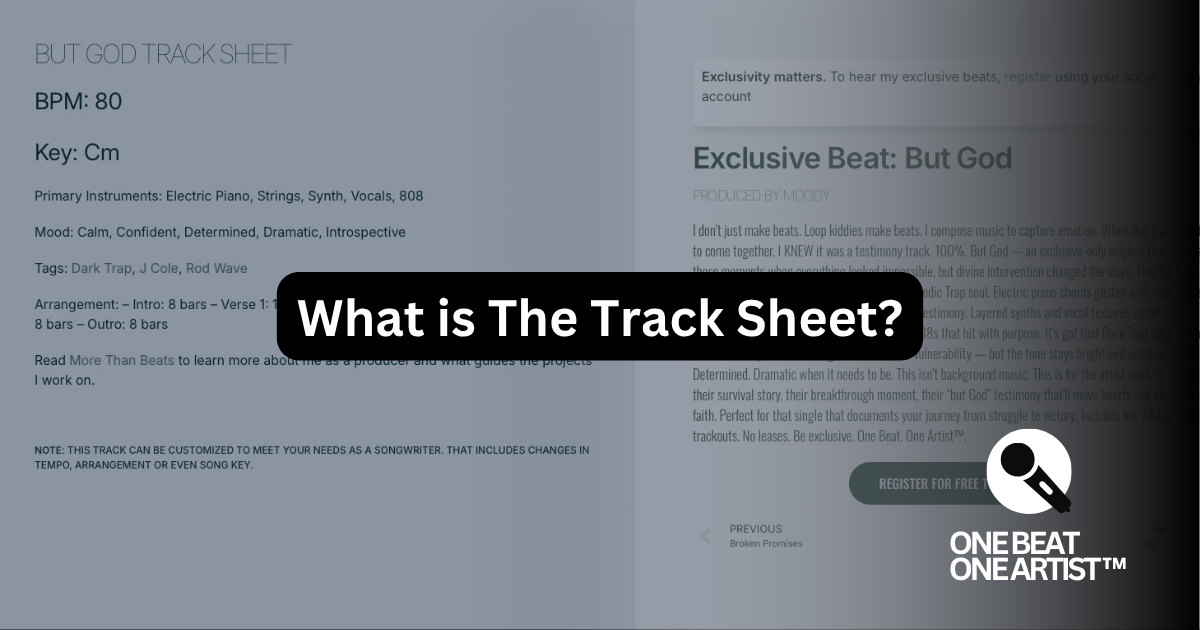
Every beat on this site has a track sheet. It lives right next to the description on the beat page. If you’ve never worked with a producer who gives you this kind of information upfront, let me walk you through what you’re looking at and why it matters before you write a single word.
BPM
BPM stands for beats per minute. It’s the tempo, the speed of the track. My track But God runs at 80 BPM. That’s a mid-tempo pace, slow enough to breathe between lines, fast enough to keep tension in the delivery. If you already write to a metronome or record with a DAW, you already know how to use this. If you don’t, just know that the BPM tells you how fast or slow the beat moves. A faster BPM often means you’ll need more syllables to fill the bar. A slower BPM gives you space, and in some cases, even allows you to fill in more syllables. It’s all about flow.
I also note this because the BPM can be adjusted. If 80 feels too slow or too fast for what you’re building, that can be adjusted.
Key
The key tells you what notes the beat is built around. But God is in C minor. This matters if you sing or not. If you freestyle or rap without worrying about pitch, you really should. For instance, I can’t sing. I have to use auto-tune. If I know the track is C minor, I set it to that or I set it to the relative key of C Minor (which is eb Major). If you’re writing a hook that requires you to hit certain notes, or if you work with a vocalist, knowing the key saves you from trying to force a melody into a range that doesn’t fit the track. Your vocal coach, your co-writer, your engineer will all appreciate you knowing this going in.
Primary Instruments
This tells you what you’re hearing in the track. For But God that’s electric piano, strings, synth, vocals, and 808. The vocals listed here are not song vocals, they’re textural elements baked into the production. The 808 is the bass. Strings means orchestral arrangement is in there. This section helps you understand the sonic palette so you know what sonic space you’re writing into.
Mood
Calm. Confident. Determined. Dramatic. Introspective. That’s the emotional range I designed this track to carry. Not every mood has to show up in your lyrics but this gives you a starting point. If you’re sitting down to write and you don’t know where to start, start with the mood. It’s already embedded in the beat. Your job is to match it or create tension against it intentionally.
Tags
Tags are reference points, not limitations. But God is tagged Dark Trap, J Cole, Rod Wave. That’s telling you the sonic neighborhood this track lives in and the type of artist energy it fits. If you hear J Cole and Rod Wave and that resonates with your style, this beat was built with you in mind.
Arrangement
This is the one most artists skip and then regret later. The arrangement tells you the structure of the track. But God is laid out as Intro, Verse 1, Hook 1, Verse 2, Hook 2, Outro, with the bar count for each section. That’s a complete song structure already built into the production. You’re not guessing where the beat changes or how long you have before the hook hits. The roadmap is right there. You can even hear it if you log into the site. Write to it. It’ll save you hours. No only that, if I posted the track on my site, it has already been tracked out to that arrangement. That means I can literally have the beat stems to you in a matter of minutes.
The Customization Note
At the bottom of the track sheet you’ll see this: the track can be customized. Tempo, arrangement, key. That’s not a throwaway line. I mean it. If you purchase a beat and the key is wrong for your voice or the arrangement doesn’t fit your vision, reach out and I will make it work. That’s part of what you’re getting when you buy exclusively through this site and from me.
Price
You’ll notice there’s no producer fee listed on any beat page.
That’s intentional.
I work with independent artists at all different stages. Some are just getting started and working with a tight budget. Some are further along and ready to invest seriously in their sound. A flat price posted on a page doesn’t account for any of that, and honestly, it doesn’t need to.
What I’m not going to do is sell myself short to make a sale easier. This is my gift and I treat it that way. But I’m also not trying to price out an artist who has something real to say and just needs the right track to say it on. Balance is key.
So pricing is handled through direct conversation. You reach out, we talk about what you’re working on, and we land on a number that makes sense for both of us. What gets agreed on is what gets paid and that is between us. Pookie and T-Bone don’t need to know. No hidden fees, no pressure, no bait and switch.
One more thing
If you want to understand why I build beats the way I do and what guides the creative decisions behind every track, the track sheet links to More Than Beats. That’s worth reading if you get a chance.
Articles
Beat Economics 101
The real math behind streaming royalties, what producer fees actually mean, and how faith shapes who I work with. A producer’s honest breakdown of how the music business actually works at the independent level.
More Than Beats
As a music producer and follower of Jesus, the question of what I’m willing to co-sign with has been a guiding principle since I started producing music for others. It’s a question that forces me to dig deep into my values and beliefs, and it’s not always easy to answer in an industry that often prioritizes profit over purpose.
Prompts Don’t Make Records. People Do.
AI already makes beats, and it’s only getting better. Here’s an honest look at what that means for producers, where the market is heading, and why some artists will always want a human in the room.